1. Introduction
Universal Mobile Telecommunication System (UMTS) currently viewed as a dream system that replaces the Global System for Mobile Communication (GSM). UMTS is an evolution satau third generation (3G) mobile networks. UMTS also shows the growing demand of mobile applications and Internet applications for new capacity so that the world increasingly crowded mobile communications. Increase network transmission speeds up to 2 Mbps per mobile user and set a standard of global exploration.
UMTS, also called Wideband - Code Division Multiple Access (W-CDMA). This system allows many different applications to be introduced into the corners of the world to mobile users and provides an important link between the present GSM system, and the last of the worldwide standard for the entire single mobile telecommunications, International Mobile Telecommunications-2000 (IMT-2000 ).
2. IMT-2000
The main characteristics of 3G systems that we know as the IMT-2000, is one family that have standards and have campatible following characteristics:
* Used throughout the world
* Used for all mobile applications
* Support for data transmission from the packed-switched and circuit switched
* Offers a high data rate up to 2 Mbps
* Offer high spectrum efesiansi
IMT-2000 is a set of requirements issued by the International Telecommunications Union (ITU). BMI represents the International Mobile Telecommunications, and describes the year 2000 which is scheduled for the beginning of the experiment system and the frequency range of 2000 MHZ (WARC'92; 1885-2025 MHz and 2110-2200 MHz). All 3G standards have been developed by regional standards developing organizations (SDOs). On the whole proposal was submitted by regional SDOs in the ITU in 1998 as many as 17 different proposals for IMT-2000 standard, 11 proposals for terrestrial systems and 6 proposals for mobile satellite systems (MSSs). At the end of 1998 it had evaluated the proposal in full, and in mid-1999 has been negotiated at a different consensus view that 17 proposals have been approved as an IMT-2000 standard by the ITU.
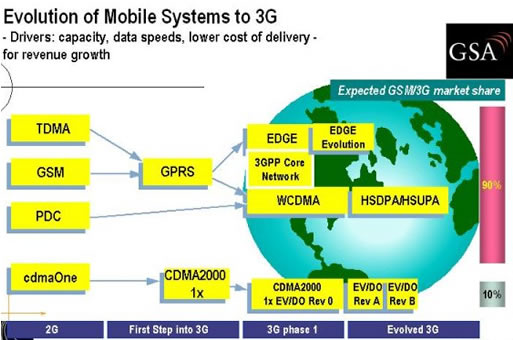
Most of the IMT-2000 proposals are UMTS (W-CDMA) as the successor of GSM, CDMA2000 as a temporary replacement for the standard '95 (IS 95), and time division - synchronous CDMA (TD-SCDMA) (universal wireless communications-136 [ UMC-136] / EDGE) as the basis for improving TDMA D-AMPS/GSM.
Most of the IMT-2000 proposals are UMTS (W-CDMA) as the successor of GSM, CDMA2000 as a temporary replacement for the standard '95 (IS 95), and time division - synchronous CDMA (TD-SCDMA) (universal wireless communications-136 [ UMC-136] / EDGE) as the basis for improving TDMA D-AMPS/GSM.
UMTS allows many applications to be introduced to users across the world and provides a variety of the most important link of the system in the present GSM and IMT-2000. The new network should also show growth in demand from mobile and Internet applications for new capacity in the world of mobile communications that have been solid. Increased transmission speed UMTS up to 2 Mbps per mobile user and set a standard of global exploration.
UMTS is developed by Third-Generation Partnership Project (3GPP), a joint venture of several SDOs - ETSI (Europe), Association of Radio Industries and Business / Telecommunication Technology Committee (ARIB / TTC) (Japan), American National Standards Institute (ANSTI) T-1 (USA), Telecommunication Technology Association (TTA) (South Korea), and Chinese Wireless Telecommunication Standard (CWTS) (China). To reach global acceptance, 3GPP is introducing UMTS in phases and annual releases. The first release (UMTS Rel. '99), Introduced in December 1999, this shows an improvement and replacement for the existing GSM networks. For the second release (UMTS Rel. '00), The same change is proposed as improvements to the IS-95 (with CDMA2000) and TDMA (with TD-CDMA and EDGE).
The most important changes in Rel. '99 Is a UMTS Terrestrial Radio Access (UTRA), a radio interface for W-CDMA land-based communications. UTRA supports Time Division Duplex (TDD) and Frequency Division Duplex (FDD). TDD model optimized for public micro and pico cells and cordless applications without a license. FDD model is optimized for a wide range of areas, namely; public macro and micro cells. Both models offer tersubut data rate dynamic and flexible up to 2 Mbps. The model described UTRA others, multicarrier (MC), is expected to be compatible between UMTS and CDMA2000.

Figure Scheme UMTS Evolution
3. The UMTS network Arsistektur
UMTS (Rel. '99) unites the increase of the GSM phase 2 + Core Network with GPRS and CAMEL. Enables network operators to enjoy increased efficiency because the cost of UMTS 2G can protect investments and reduce the risk of these implementations.
In UMTS release 1 (Rel. '99), has introduced a new radio network kases UMTS Terrestrial Radio Access Network (UTRAN). UTRAN, UMTS Radio Access Network (RAN), can be connected to the GSM phase 2 + Core Network (CN) via Iu. A UTRAN Iu interface between the Radio Network Controller (RNC) and CN; UTRAN interface between RNC and packet-switched domain of CN (Iu-PS) is used for PS data and the UTRAN interface between RNC and the circuit-switched domain of CN (Iu - CS) was used for the CS data.
Mobile Stations (MSS) "GSM-only" will be connected to the network via the GSM air (radio) interface (Um). UMTS / GSM dual-mode user equipment (UE) will be connected to a UMTS network over the air (radio) interface (Uu) on the data rate is very high (close to 2 Mbps). Outside the service area of the UMTS, UMTS / GSM UE will be connected to the network by reducing the data rate through Um.
Maximum data rate is 115 kbps for CS data by HSCSD, 171 kbps for PS data by GPRS, and EDGE 553 kbps by. Support handover between UMTS and GSM, and handover between UMTS and other 3G systems (eg, multicarrier CDMA [MC-CDMA]) will be able to support all around the world access to the right.
Public Land Mobile Network (PLMN) described in UMTS Rel. '99 Unites major kategari of 3 network elements:
Phase ½ * GSM core network elements; mobile service switching center (MSC), visitor location register (VLR), home location register (HLR), authentication center (AC), and equipment identity register (EIR).
* GSM Phase 2 + enhancements; GPRS (serving GPRS support node [SGSN] and the gateway GPRS support node [GGSN]) and CAMEL (CAMEL service environment [CSE])
* Improvement and UMTS specific modifications, especially the UTRAN.
3.1. Network elements of GSM Phase ½
½ PLMN GSM phase contains from 3 subsystem; base station subsystem (BSS), network and switching subsystem (NSS), and operations support system (OSS). BSS contains a few functional units; base station controller (BSC), transcievier base station (BTS) and transcoder and rate adapter unit (Trau). NSS contains several functional units; MSC, VLR, HLR, EIR, and AC. Seoerti MSC provides switching functions, signaling, paging, and inter-MSC handover. OSS includes operation and maintenance centers (OMSs), which is used for remote operation and Centralized task, administration, and maintenance (OAM).

Phase UMTS network Figure 1
3.2. Network elements of GSM Phase 2 +
3.2.1. GPRS
Most important from the evolutionary GSM to UMTS is GPRS. PS introducing GPRS into GSM CN and allow direct access to packet data networks (PDNs). PS This transmission allows for high data rates well beyond the 64 kbps limit of ISDN through the GSM CN, the data transmission rate for UMTS is required up to 2 Mbps. GPRS will prepare and CN menoptimalisasi for high data rate PS transmission, as well as UMTS with UTRAN the RAN. As such, GPRS is a prerequisite for the introduction of UMTS.
Two of these functional units extends from the architecture to the GSM NSS PS GPRS services; GGSN and SGSN, GGSN has the function of comparing the gateway MSC (GMSC). SGSN is at the same hierarchical level as the visited MSC (VMSC) / VLR and carry out comparable functions like routing and mobility management.
3.2.2. CAMEL
CAMEL enables worldwide access to the operators who use IN applications such as prepaid, call screening, and supervision. CAMEL is a major increase in GSM phase 2 + to the introduction of the concept of UMTS virtual home environment (VHE). VHE is a platform of flexible service definition (collection from service creation tool) that allows operators to modify or penigkatan existing services or create new services. Moreover, VHE enables worldwide access to operator-specific services in every GSM and UMTS PLMN and introduces location-based services (by interaction with the GSM / UMTS mobility management). A CSE and a new protocol of the common control signaling system 7 (SS7) (CCS7), CAMEL application part (CAP), used in the CN to introduce the CAMEL.
3.3. UMTS network elements of Phase 1
Has been mentioned above, that different UMTS with GSM phase 2 + most of the new principles for air interface transmission (W-CDMA instead of TDMA / FDMA). Therefore, a new RAN is called UTRAN must be introduced with UMTS. Only projection modifications, such as the allocation of trnascoder (TC) function for voice emphasis on the CN, the CN is required to accommodate the change. The function TC is used in conjunction with the interworking function (IWF) for protocol conversion between the interfaces A and Iu-CS.
3.3.1. UTRAN
UMTS standard can be seen debagai an extension of the existing network. Two new network element has been introduced in the UTRAN, RNC, and Node B. Divided again in the UTRAN radio network system (RNSs) the individual, where each RNS is controlled by the RNC adalan. RNC is connected to a set of Node B elements, which each Node B can serve one or several cells.

Figure UMTS phase 1: UTRAN
Existing network elements, such as MSC, SGSN, and HLR, front extended to adopt the UMTS requirements, but the RNC, Node B, and the new handsets to be designed all. RNC will be a replacement for BSC, and Node B will function almost the same as the BTS. GSM and GPRS networks will be developed, and new services will be integrated into the overall network that contains both the existing interfaces such as A, Gb, and Abis, and including the Iu which is a new interface, UTRAN interface between Node B and RNC (Iub), and the UTRAN interface between two RNCs (Iur). new open interface in UMTS:
* Uu: UE interface to Node B (UTRA, the UMTS W-CDMA air interface)
* Iu: RNC interface to GSM phase 2 + CN (MSC / VLR or SGSN), which consists of the Iu-CS is used for data communications circuit-switched and Iu-PS is used to communicate packet-switched data.
* Iub: RNC to the Node interface B
* Iur: RNC to RNC interface, not comparison to other interfaces in GSM
RNC allows autonomy from the radio resource management (RRM) by the UTRAN. RRM perform the same functions as the GSM BSC, providing central control Untk RNS elements (RNC and a Node B). RNC handles protocol exchanges between the interfaces Iu, Iur, and Iub and is responsible for Centralized operation and maintenance (O & M) of the entire RNS with access to the OSS. Because the ATM-based interface, RNS ATM cell transfer between the interfaces Iu, Iur, and Iub. The user data in circuit-switched and packet-switched interface besaral of Iu-CS and Iu-PS is multiplexed together for multimedia transmission via Iur interfaces, Iub, and Uu to and from the EU.
RNC using the Iur interface, which is not the same as in GSM BSS, the autonomy to handle 100 percent of the RRM, removing the burden from the CN. Serve functions such as admission control, connection to the EU PRC, or macro diversity handover and congestion fully regulated by the serving RNC (SRNC) single. If another RNC is involved in the active connections through a soft inter-RNC handover, declared as a drift RNC (DRNC). DRNC only responsible for the allocation of the source code. A possible to re-allocate from SRNC to DRNC functions of the previous (re-allocation of serving radio network subsystem [SRNS]). Part of the controlling RNC (CRNC) is used to describe the RNC that control the logic resources of UTRAN access points.
3.3.2. Node B
Node B is a physical unit of the transmission / reception radio using the cell. Depending on sektorisasinya (omni / sector cells), one or more cells can be served by node B. A single Node B can support both models of the FDD and TDD, and the model may be co-located with GSM base stations to reduce the cost of implementation. Node B is connected with the EU through the radio interface Uu W-CDMA and connected to RNC via the Iub interface-based ATM. Node B is the point of the ATM terminal. The main task of Node B is to convert data from and to the radio interface Uu, including forward error correction (FEC), adaptation values, spreading / despreading W-CDMA, and modulation Quadrature phase shift keying (QPSK) at the air interface. Node B measures the strength and quality of connections and determine the frame error rate (FER), data transmission is addressed to the RNC as a measurement of the handover report, and a combination of macro diversity. Node B is also responsible for the FDD softer handover. The combination of micro diversity is free, remove the need for additional transmission capacity in the Iub.
Node B also beparsitipasi in power control, as something that allows for adjustment of the downlink using the command (DL) transmission power control (TCP) through the inner-loop power control information based on the uplink (UL) TCP. Values that are known from the inner-loop power control comes from the RNC via outer-loop power control.

Figure Overview Node B
4. Reference
* Http://www.iec.com [the international engineering consortium]
* Http://www.umtsworld.com [news and information about 3G mobile networks]
 Mobile data communications is evolving quickly because of Internet, Intranet, Laptops, PDAs and increased requirements of workforce mobility. 3G UMTS will be the commercial convergence of fixed line telephony, mobile, Internet and computer technology. New technologies are required to deliver high speed location and mobile terminal specific content to users. The emergence of new technologies thus provides an opportunity for a similar boom what the computer industry had in 1980s, and Internet and wireless voice had in 1990s.
 The UMTS transport network is required to handle high data traffic. A number of factors were considered when selecting a transport protocol: bandwidth efficiency, quality of service, standardisation stability, speech delay sensitivity and the permitted maximum number of concurrent users. In the UMTS network, ATM (Asynchronous Transfer Mode) is defined for the connection between UTRAN and the core network and may also be used within the core network. In addition to the IMT-2000 frame many new standards will be integrated as part of the next generation mobile systems. Bluetooth and other close range communication protocols and several different operating systems will be used in mobiles. Internet will come to mobiles with WAP, i-mode and XML protocols. 3G development has helped to start the standardisation and development of large family of technologies.